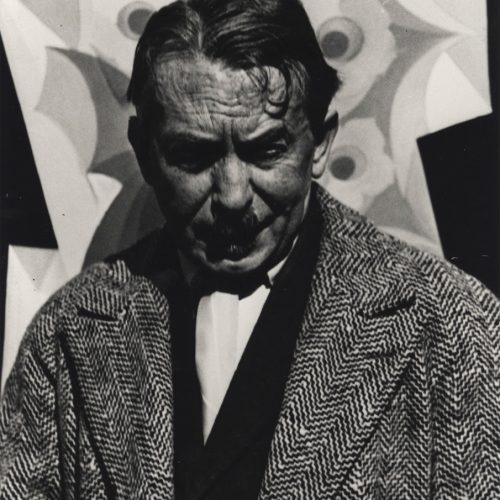
One of the greatest representatives of Futurism, Giacomo Balla was born in Turin in 1871. After finishing high school, he enrolled at the Accademia Albertina; he also began to follow the lessons of the famous anthropologist and criminologist Cesare Lombroso. As a painter, he made his debut in 1891 at the Society for the Promotion of Fine Arts. He frequented the aristocracy and upper middle class in Turin and met the writer Edmondo de Amicis and the artist Giuseppe Pellizza da Volpedo, the leader of Italian Divisionism.
In 1895 Balla moved to Rome with his mother, where he remained for the rest of his life. Here he was welcomed by Umberto Boccioni, Gino Severini and Mario Sironi as a Master of Divisionism.
He joined Futurism even though he was the oldest member of the group and in 1910 signed the Manifesto of Futurist Painting together with Umberto Boccioni, Luigi Russolo, Gino Severini and Carlo Carrà. During these years, Balla moved from a realist language typical of the turn of the century to an avant-garde artistic research. His studies on speed, dynamism and the effects of light made him one of the most active protagonists of Futurism, to the point of signing his works with the pseudonym Futurballa.
Starting in 1929 after the drafting of the Manifesto of Futurist Airpainting, Balla dissociated himself from Futurism, convinced that only in realism can there be pure painting. From the 1930s onwards, in fact, his works are characterised by an exclusively figurative representation with bright, luminous colours. Balla died on 1 March 1958 in Rome.