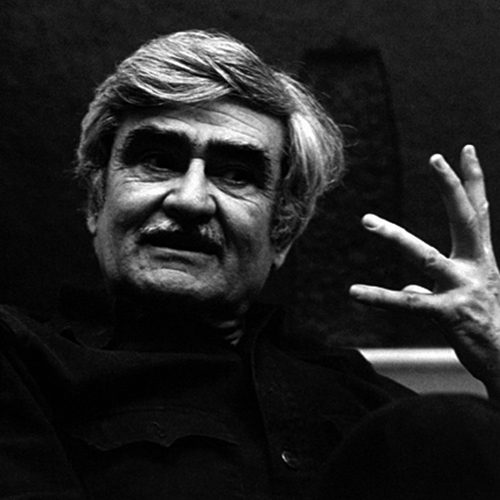
Città di Castello, 1915 – Nice, 1995
Alberto Burri was born in Città di Castello (Perugia) on 12 March 1915. He graduated in medicine in 1940. A medical officer in World War II, he was taken prisoner by the British in Tunisia in 1943 and sent to a detention camp in the USA in Hereford, Texas. Here he gave up the medical profession and began to paint.
After the war, he returned to Italy in 1946 and settled in Rome where he devoted himself entirely to painting; it was here that he had his first solo exhibitions in 1948. At the end of the 1940s, he started abstract painting based on extra-pictorial materials such as pumice and tar, the material itself being the basis of his painting. In 1951, he participated in the foundation of the Roman group Origine.
In the 1950s, he developed other types of works, such as Sacchi and Combustioni, Legni and Ferri. In the 1960s, he also worked on the Plastiche, works characterised by the use of fire.
In the 1970s Burri began a progressive exemplification of the formal aspects of his painting with the Cretti and Cellotex series. In 1978, Burri founded the Fondazione Palazzo Albizzini Collezione Burri in Città di Castello, with the task of promoting, managing and disseminating his work.
In 1985, he conceived and started making the large white cement Cretto that covered the rubble of Gibellina, destroyed by the Belice earthquake.
Burri is internationally recognised as one of the leading artists of the second half of the 20th century. He died in Nice on 13 February 1995.