Berlin, 1895 – Saint Tropez, 1971
Massimo Campigli (pseudonym of Max Ihlenfeld) was born in Berlin in 1895. He spent his childhood in Florence and in 1909 moved to Milan, where he came into contact with the Futurists. After the First World War, he moved to Paris, where he was a correspondent for the Corriere della Sera. In the meantime, he began to paint as a self-taught artist, fascinated by metaphysics, Léger and Picasso’s neoclassical painting, but also by ancient art and Etruscan art in particular.
In 1928 he was invited to the Venice Biennale with a personal room; in 1929 with Giorgio de Chirico, Gino Severini and other artists he formed the group Seven Italians in Paris. Of the same year was his first solo exhibition at the Galerie Jeanne Bucher in Paris.
During the 1930s, he returned to Milan, where he signed the ‘Manifesto of Mural Painting’ with de Chirico, Achille Funi and Mario Sironi in 1933. Among the mural paintings he executed, between 1939 and 1940 he created a large monumental decoration for the atrium of the Liviano, the headquarters of the Faculty of Literature in Padua.
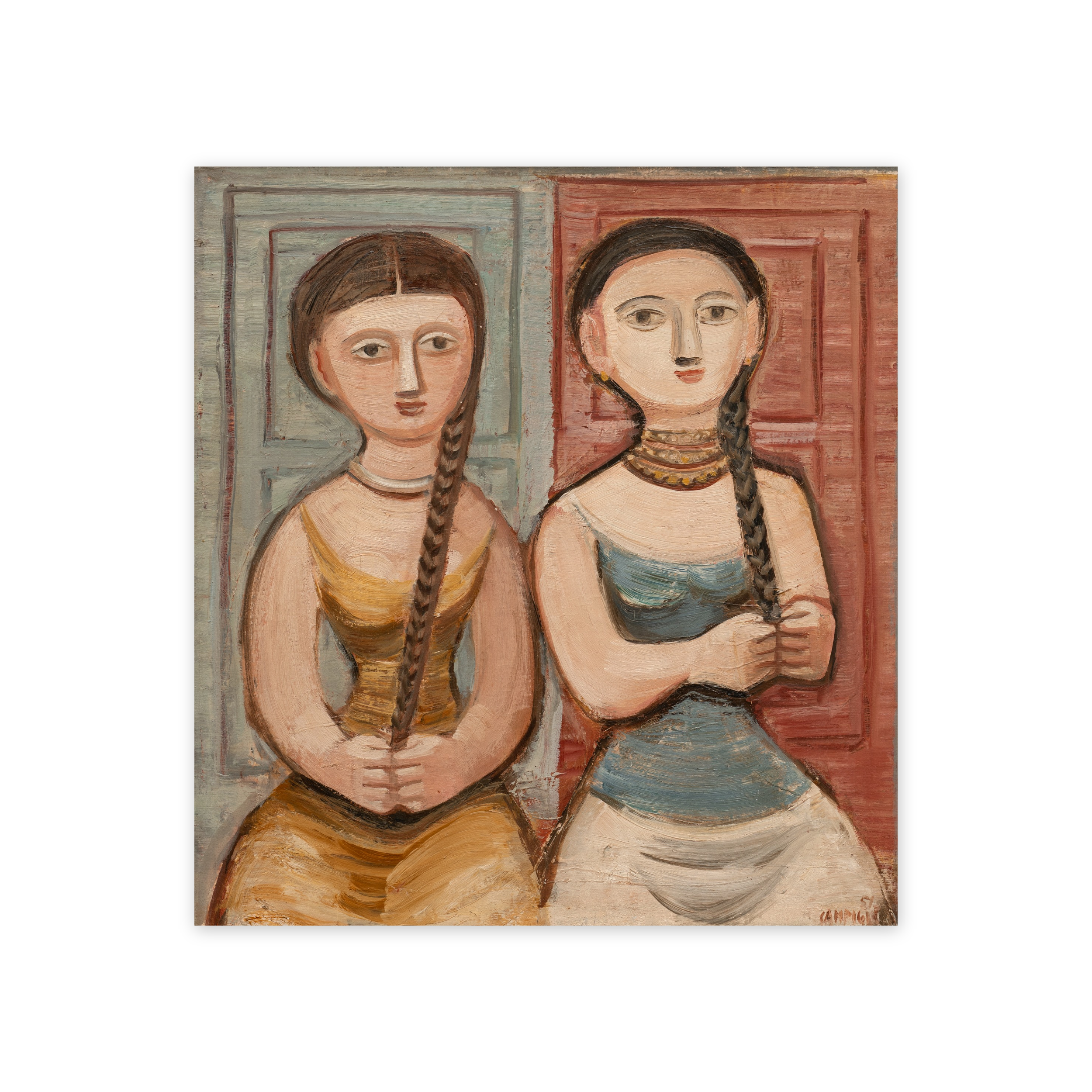
His painting is characterised by a dreamy and timeless dimension, harmoniously blending ancient and archetypal motifs with evocative female presences, his favourite subjects. In 1946, Stedelijk Museum in Amsterdam dedicated a solo exhibition to him. Two years later, he returned to Paris, where, by then an established painter, he devoted himself exclusively to his delicate, earthy-coloured painting, inhabited by stylised female creatures.
Innumerable were his participations in international festivals and exhibitions abroad. Dividing his time between Paris, Milan, Rome and Saint Tropez, he devoted himself passionately to the large anthological exhibition held at Palazzo Reale, Milan, in 1967. He died in 1971 in Saint Tropez.
© MASSIMO CAMPIGLI, by SIAE 2026