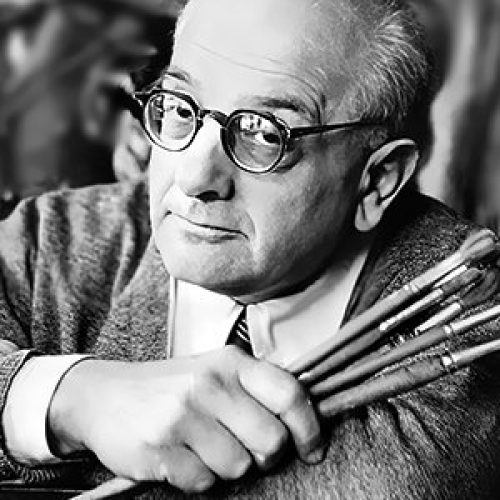
Athens, 1891 – Rome, 1952
Alberto Savinio was born in Athens in 1891 to Italian parents, with the name Andrea de Chirico, brother of Giorgio de Chirico. Upon the death of their father in 1905, the two brothers and their mother left Greece and, after various stops in Venice and Milan, moved to Munich.
In 1910, he decided to go to Paris, where he immediately became friends with Apollinaire; during this period, he also decided to change his name to Alberto Savinio.
At the outbreak of the First World War, he returned to Italy with his brother; the two settled in Ferrara, staying at the military hospital, and it was here that, together with Carla Carrà, Filippo de Pisis and his brother Giorgio, he spread the metaphysical painting movement. In 1917, he was sent to Thessaloniki as an interpreter; from the eastern front, he sent literary texts to many Italian and foreign avant-garde magazines such as Tristan Tzara’s “Dada”.
After the war, he actively participated in the magazine Valori Plastici and continued his literary activity. In 1926, he sent a group of paintings on paper to his brother de Chirico in Paris. A few months later, he moved to Paris and began working as a painter. In 1927, he had his first exhibition at the Galerie Bernheim Jeune.
In 1933, he returned to Italy for good. Due to the economic crisis, he lived in Turin, then in Milan, and finally settled in Rome in 1937. In the 1930s, Savinio continued and intensified his portrait painting. He continued to combine his painting with literary activities and contributions to newspapers and magazines.
He held numerous exhibitions, such as in 1940 at the Galleria Il Milione in Milan and in 1950 at the Galleria La Bussola in Turin and then at the Galleria Lo Zodiaco in Rome. In the 1940s and 1950s, he also intensified his publication of writings, books and plays, in addition to collaborating on stage productions.
On 5 May 1952, he died suddenly in Rome.