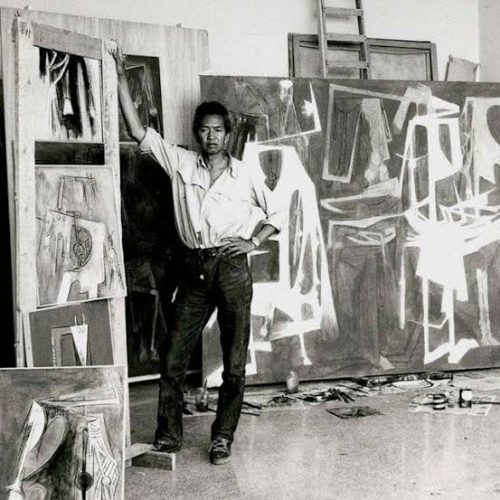
Wifredo Lam was born in 1902 in Cuba, the son of a Chinese father and an Afro-Cuban mother of Spanish origin. He moved with his family to Havana and enrolled at the Academy of Fine Arts; in 1923 he won a scholarship to study at the Prado Museum in Madrid, where he stayed until 1938, when he then moved to Paris. Here he befriended Pablo Picasso, who introduced him to painterly friends, poets and art critics on the Parisian scene.
In 1941, he fled occupied France and returned to Cuba after an absence of around 20 years. Here, his painting enriched with new creative ideas, drawing on the island’s culture. His style incorporates elements of Afro-Cuban culture, incorporated with strong European influences experienced in Europe. Drawing on Cubism and Surrealism, Lam combines Western modernism with African art and Caribbean symbolism, developing a syncretic style that allows him to express the hybrid quality of Cuban identity.
In 1952 Lam settled in Paris. In the 1950s, he collaborated with the artists of the CoBrA group and joined the Situationist movement. He also travelled to Italy, to Albissola, where an international meeting of sculpture and ceramics was organised on the initiative of Asger Jorn. In the 1950s and 1960s, this small village on the Ligurian coast was transformed into a place of encounter and artistic experimentation. In Albissola, Lam set up a studio, dividing his time between Liguria and Paris.
Lam’s style is the sum of the many pictorial currents he encountered during his extensive travels, which brought him into contact with the main avant-garde movements of his time – from Cubism to the CoBrA group – inventing a highly personal visual universe expressed in a unique and original language.
He died in Paris in 1982.