
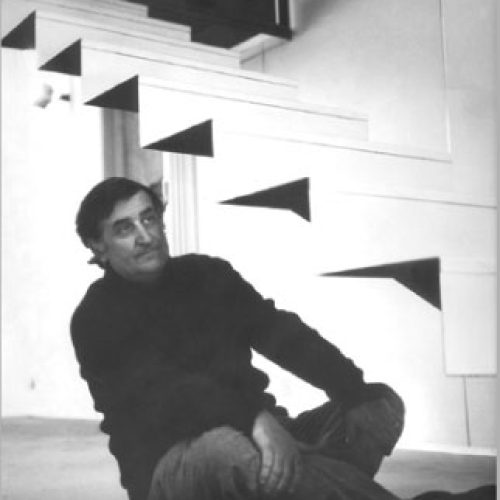
Genoa, 1922 – Milan, 1986
Emilio Scanavino was born in Genoa on 28 February 1922. He attended art school, where he developed a passion for literature and poetry. He graduated in 1942, the same year he held his first solo exhibition at the Galleria Romano in Genoa. He enrolled at the Faculty of Architecture in Milan, but dropped out when the Second World War broke out.
After the war, he worked as a technical draughtsman for the City of Genoa, a role he later left to devote himself entirely to painting. In 1946, he took a studio in Milan and began frequenting the Brera and Bar Jamaica circles, where he met, among others, Fontana, Dova, Crippa, Manzoni and Dadamaino.
A stay in Paris in 1947 brought him into contact with avant-garde artists, prompting him to revisit the Cubist tradition: his painting became progressively more abstract and gestural, seeking a more symbolic, restless and dramatic language that would characterise all his subsequent work.
Alongside his paintings, Scanavino began an important ceramic production as early as the late 1940s, thanks to his friendship with Tullio Mazzotti of the Albisola ceramic factory. It was here that Scanavino met Carlo Cardazzo, founder of the Galleria del Naviglio in Milan and the Galleria del Cavallino in Venice, and formed friendships with artists working in Albisola, including Asger Jorn and Karel Appel.
In 1950, he exhibited at the Venice Biennale, where he returned in 1960 and 1966 with a solo exhibition. At the 1966 Biennale, he presented an octagonal installation designed in collaboration with the architect Scarpa and won the Pininfarina Prize. He had numerous exhibition opportunities and took part in shows both nationally and internationally, thanks to his contacts and frequent trips abroad.
In 1962, he converted an old house in Calice Ligure into a studio, where he spent much of his time painting and sculpting; numerous artists subsequently settled in this town, forming a small community. In the 1960s and 1970s, his artistic exploration evolved towards an even more essential style, alongside grids and geometric structures. The artist’s palette is limited, devoted almost exclusively to black and shades of grey, with frequent, often dramatic touches of red.
He passed away in Milan in 1986.
WhatsApp Us