
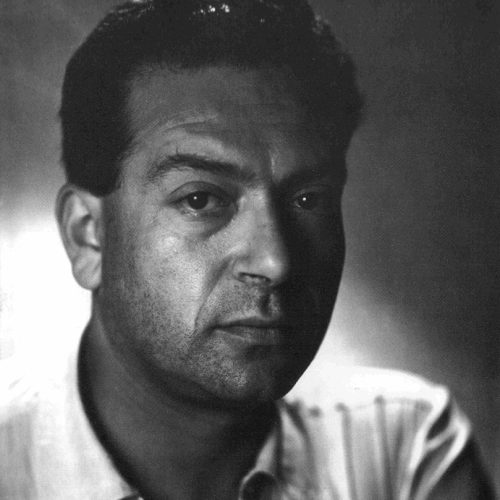
Bagheria, 1911 – Rome, 1987
Renato Guttuso was born in 1911 in the Sicilian town of Bagheria. A lover of painting from an early age, Guttuso, after completing his classical studies in Palermo in 1930, enrolled in the Faculty of Law, a university that he soon abandoned to devote himself entirely to painting.
In 1931, he participated in the Quadriennale in Rome and the following year in a group exhibition dedicated to Sicilian painters, organised by the Galleria del Milione in Milan. After moving to Rome, he became associated with the artists of the Roman scene, including Mario Mafai, Corrado Cagli, Pericle Fazzini, Mirko and Afro Basaldella. In 1938 he had his first solo exhibition at the Galleria della Cometa and the following year in Milan he participated in the exhibition of the Roman group Corrente.
Active in the resistance during the Second World War, in 1945 he was in Paris where he befriended Pablo Picasso. After the war he joined the Fronte Nuovo delle Arti group with, among others, Leoncillo Leonardi, Morlotti, Vedova and Corpora, artists united by a common desire for renewal and commitment rather than a shared stylistic orientation.
A firm believer in Realism, his painting is characterised by intense dramatic accents and rigorous chromatic research, with the intention of moving beyond expressionistic denunciation to a broader, choral vision. His canvases alternate social subjects with landscapes of his beloved Sicily, as well as scenes from everyday life.
After the dissolution of the Front in 1950, Guttuso’s art continued to remain linked to social themes, gaining more and more political weight. In fact, the artist oriented his painting towards an increasingly realist matrix, depicting scenes linked to popular and protest movements, accentuating the expressionist component.
He received numerous acknowledgements in Italy and abroad, such as his participation in the Venice Biennale (1948, 1950, 1952, 1995), the Rome Quadriennale (1931, 1935, 1937), as well as personal exhibitions at Palazzo Grassi in Venice (1981), Palazzo Reale in Milan (1985), the Stedelijk Museum in Amsterdam (1962) and the Kunstverein in Frankfurt (1975). He died in Rome in 1987.
WhatsApp Us