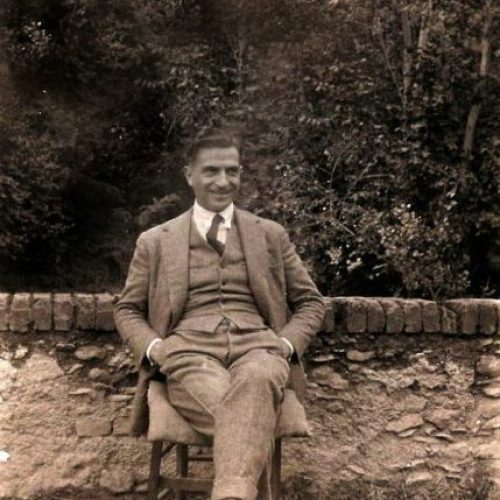
One of the most important Italian painters of the early 20th century, Felice Casorati was born in Novara, in 1883. During his childhood and adolescence, the family moved often, following his father, a career officer. After graduating in law from Padua in 1906, he began to devote himself to artistic practice under the guidance of Giovanni Vianello. In 1911 he moved to Verona, where the artistic environment was influenced by the Secessions of Munich and Vienna and he approached the young artists gravitating around Ca’ Pesaro. He participated in several editions of the Venice Biennale (1909, 1910, 1912 and 1914) and in the main exhibitions of the period.
In 1917 he moved to the house-studio in Via Mazzini in Turin, where he would live all his life, making himself a promoter of Turin’s cultural and artistic life. World War I left a deep mark on Casorati’s painting, which was characterized by sad and anguished atmospheres based on realistic imagery often investigated in the most minute details to the point of being alienating.
Renown internationally, he was awarded the Carnegie Prize in Pittsburgh in 1937, the Venice City Council Prize at the 1938 Biennale, the Grand Prix in Paris in 1939, and in the same year the Painting Prize at the San Francisco International Art Exhibition. In 1941 he became Chair of Painting at the Albertina Academy in Turin, where he would later become director in 1952.
Despite health problems, he was still present at the Venice Biennale in 1962. He disappears in Turin in 1963.